
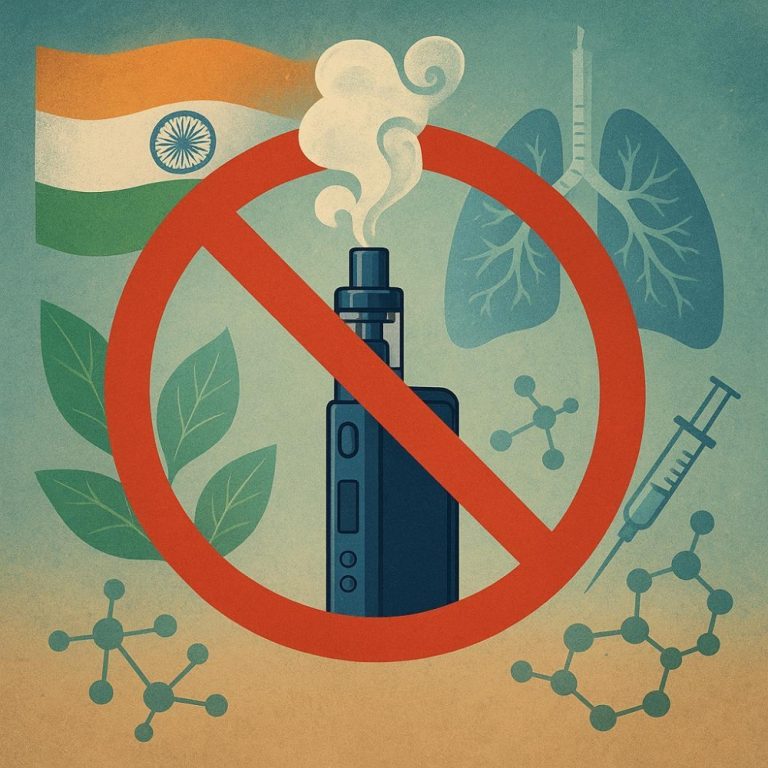

India’s ban on e-cigarettes remains in force, the Health Ministry has reaffirmed. The law prohibits their production, sale, import, distribution, storage and advertising, treating vaping products as a public-health concern rather than an alternative outside the rules for tobacco products.
Table of Contents
- India’s Vape Ban Gets Another Firm “No”
- Ministry Warns Sellers: E-Cigarettes Remain Off the Menu
- The Message Is Clear; Enforcement Is the Next Test
The Ban Remains in Place
India’s vape ban is not new. The health Ministry’s reaffirmation makes clear that the government has no plans to allow e-cigarettes as an alternative to conventional tobacco products. The Prohibition of Electronic Cigarettes Act, 2019, covers devices commonly sold as vapes, along with products such as e-hookahs.
The Act prohibits the production,manufacture,import,export,transport,sale,distribution,storage and advertising of e-cigarettes. Its definition includes devices that heat a substance to produce an aerosol for inhalation, whether or not the substance contains nicotine or flavourings. Changing a product’s name or branding does not, by itself, put it outside the law.
For sellers and distributors, the message is straightforward: India’s national ban still applies. Describing a vape as nicotine-free or marketing it for another purpose does not automatically make its sale lawful.
What the Law means for Sellers
The restrictions apply to retailers, distributors and importers. The Act bars the sale,distribution and advertising of e-cigarettes,so promoting a vape on social media does not avoid the rules that apply to selling it in a shop.
the law also sets out penalties. A first conviction for offences such as selling or distributing e-cigarettes can bring up to one year in prison, a fine of up to ₹1 lakhor both. For subsequent convictions, the maximum rises to three years in prison, a fine of up to ₹5 lakhor both.
Storage carries a separate penalty: up to six months’ imprisonment, a fine of up to ₹50,000or both.The restrictions therefore extend beyond the point of sale; businesses should not assume that keeping unsold devices in stock carries no legal risk.
Enforcement Is the Next Test
The ministry’s reminder does not introduce a new ban. It reinforces that the Prohibition of Electronic Cigarettes Act, 2019, remains in force. How consistently authorities enforce it across shops,supply chains and online advertising will shape what happens next.
The Act allows authorized officers to search premises and sieze e-cigarettes when they have reason to believe an offense has occurred. Its restrictions cover storage, distribution and advertising as well as sales.
For consumers, e-cigarettes are not a legally approved alternative to smoking in India. For businesses, changing a label or moving promotion online does not sidestep the restrictions. The law applies to the product and the activity, not just the words used to market it.


