
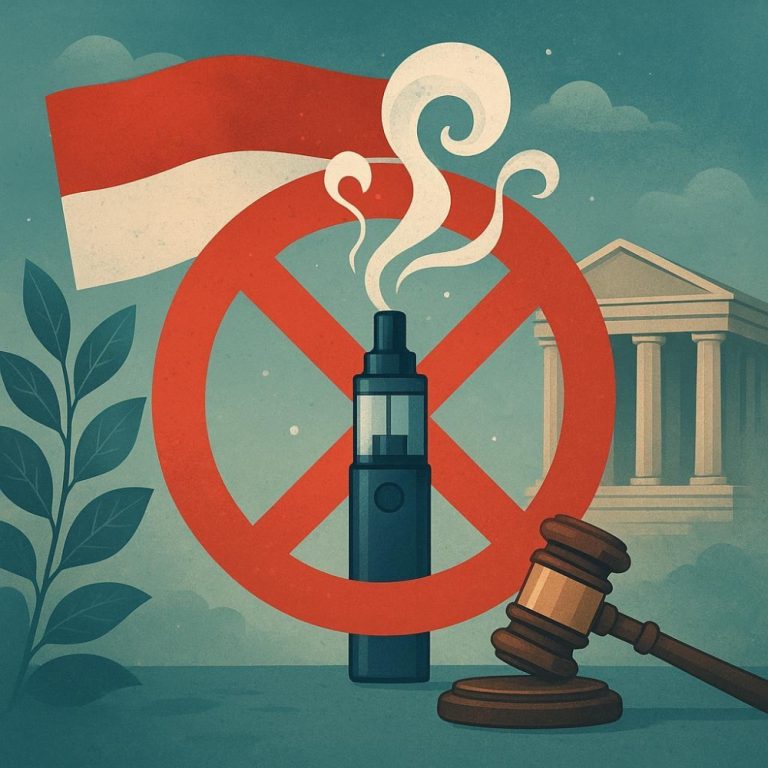

Indonesia is weighing a possible total ban on vaping while the Constitutional Court considers a related legal challenge. The proposal is still under discussion; it is not a new rule that vapers or businesses must follow.
The court’s review and the government’s deliberations are separate matters. One concerns how the law applies to the case before the court; the other is about what policy the government should pursue. Keeping that distinction in mind helps make sense of what happens next.
Table of contents
- Indonesia Puts a Total Vape Ban on the Table
- Health claims and Personal Choice Cloud the Debate
- Court Review Could Shape the Future of Vaping in Indonesia
Indonesia Puts a Total Vape ban on the Table
Officials are considering whether tighter controls would be enough or whether vaping products should be prohibited altogether. For now,the Indonesia vape ban under discussion has not changed the rules for consumers or businesses.
A “total ban” could mean different things, such as prohibiting imports and sales, restricting useor some combination of measures. the government would need to spell out the scope of any proposal and explain how it would affect retailers, manufacturers and adult consumers.
The constitutional Court’s review is related to the broader debate, but it addresses a legal challenge rather than setting government policy. The two processes may intersect, though one does not automatically determine the other.
Health Claims and Personal Choice Cloud the Debate
Those calling for tighter restrictions point to the health risks of vaping.Many products contain nicotine, which is addictiveand vape aerosol is not simply water vapor: depending on the product, it can contain fine particles and other chemicals.
At the same time, vaping should not be described as having exactly the same risks as smoking combustible tobacco. It is indeed not risk-free, but the distinction matters when policymakers consider whether regulation or prohibition is the more appropriate response.
Adult users may view vaping as an alternative to smoking.Parents and public-health advocates, simultaneously occurring, are concerned about nicotine exposure and the appeal of vape products to young people. Any proposed vape ban in Indonesia would need to define which products and activities it coversand make clear what evidence supports the measure.
Court Review Could Shape the Future of Vaping in Indonesia
The court’s decision could clarify how existing law applies to the dispute before it. Its effect will depend on the claims in the case and the ruling itself; a review should not be taken as confirmation that the government has decided to ban vaping.
The policy debate may continue whatever the court decides. Any new restrictions would need to be announced through the relevant official process before consumers and businesses could know what rules apply.
For now, the clearest updates will come from the court’s published documents and formal government announcements. Until those provide more detail, a total ban remains a possibility under discussion, not a new prohibition.


