
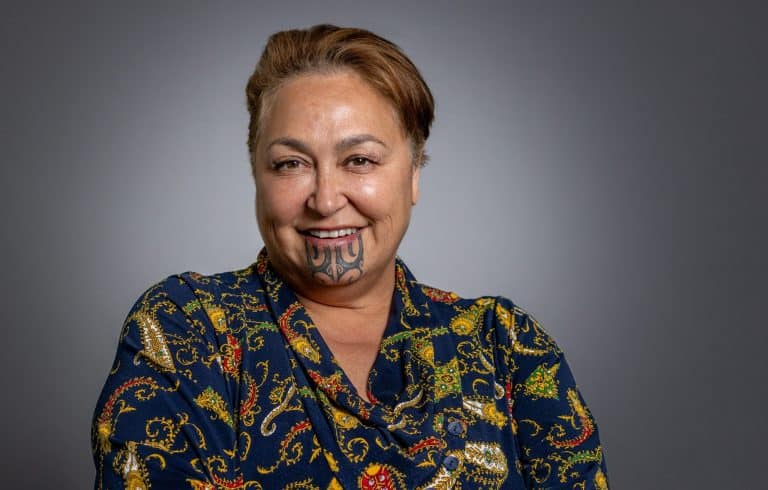

Hikitia Ropata heads the Āti Awa Toa Hauora Partnership Board. (Photo supplied)
This week, the Āti Awa Toa Hauora Partnership Board launched Whaitua, a tool to help whānau understand what’s going on in their communities — and to help them advocate for change.
Hikitia Ropata — head of the iwi Māori partnership board, whose rohe stretches from Kāpiti in the north, down to Porirua, Te Awa Kairangi, and Pōneke — explains.
Picture two communities in our rohe.
One is nestled in the hills above Wellington, where families have no local vape shops, just one upmarket bottle store, and a GP clinic that’s accepting new patients.
The other lies alongside the eastern Hutt hills, where there are multiple vape shops, three bottle stores, two dairies selling alcohol, and a medical centre that isn’t enrolling anyone new. The nearest accepting GP is a 90-minute walk away.
If our tamariki grow up in neighbourhoods where liquor stores are closer than libraries, where pokies outnumber playgrounds, and vape shops are easier to find than doctors — if their homes are colder, damper, and less healthy, and the doctors aren’t accepting new patients — then our babies are pushing against strong headwinds.
These conditions aren’t accidental. They’re the direct result of policy decisions and planning choices.
If we truly want our whānau to thrive, we need to start flipping these facts. That means using our own stories, backed by our own data, to hold decision-makers accountable — and to reshape our neighbourhoods into spaces where health and wellbeing come first.
This is where our Whaitua geo-mapping tool comes in. Whaitua gives our whānau one of the most powerful weapons for tino rangatiratanga: knowledge.
Born out of our whakaaro as an Iwi Māori Partnership Board, Whaitua responds to a gap. There was no single place where communities could see the big picture — where their GP clinics are, where their population clusters are, and how that overlaps with things like vape shops, fast food outlets, or access to green spaces.
The data existed, but it wasn’t accessible or meaningful for our whānau. We dreamed of a visual, map-based tool to bring all this information together — to help whānau understand what was going on in ourcommunities and help spark kōrero about what needs to change.
So, three years ago, we partnered with Te Tāhū Hauora (the Health Quality & Safety Commission) to build that dream. And this week, we launched Whaitua as a free, interactive tool that helps whānau anywhere in Aotearoa to tell their own stories with data.
It’s not just for policymakers. It’s designed for communities, so we can see the shape of our lives and ask hard questions:
“Why are there more vape shops than GPs in my suburb?”
“Who approved this, and why?”
“Too often, we’re blamed for conditions that have been imposed on us. Whaitua helps our whānau, hapū, and iwi to advocate for ourselves and to challenge the narratives that unfairly place the blame on our shoulders.” — Hikitia Ropata, manahautū of the Āti Awa Toa Hauora Partnership Board.
Whaitua equips our families with real information about the communities we call home. Whānau can see exactly how many vape shops or liquor stores exist compared to doctors, chemists, or libraries. It highlights the prevalence of cold, unhealthy housing and clearly maps access — or the lack of access — to essential services.
Too often, we’re blamed for conditions that have been imposed on us. Whaitua helps our whānau, hapū, and iwi to advocate for ourselves and to challenge the narratives that unfairly place the blame on our shoulders.
We know that it’s about the social determinants of health. We don’t separate health from housing or whenua. We know that cold homes lead to sickness, that food insecurity affects every part of a child’s future, and that mental wellbeing is shaped by whenua, whakapapa, and the systems around us.
Increasingly, our tamariki are growing up surrounded by polluted waterways — places they’ve never swum in or gathered kai from. These are realities our tīpuna never dreamed of for their mokopuna.
Our mahi acknowledges this truth: Oranga wai, oranga whenua, oranga whānau.
As Matariki draws to a close, we reflect on our journey and plan for the wellbeing of our communities in the years ahead.
This year, my whānau buried a very dear uncle. He spent his last days battling COPD — still organising food parcels for our kaumātua and dropping off kai to younger cousins doing it tough. That’s who he was.
Like many of our people, he carried the load even when he was unwell. We all have that kuia, whanaunga, or nephew who donates hundreds of hours for tangihanga, pōwhiri, free te reo and tikanga lessons, fundraising and organising. Often, no one thanks these whanaunga. And definitely, no one pays them.
That’s what leadership looks like in our world. We don’t wait to be called on in a crisis. We act because we’re accountable to our whānau, our whenua, our whakapapa.
Iwi Māori Partnership Boards weren’t created by accident. They come from decades of pushing, building, and fighting to have a seat at the table. But we don’t sit there for ourselves. We sit for those who can’t, and for those who come next.
Our job is to monitor the health system and ensure it serves our families. So instead of trying to fit into a system that fails us, we’re calling it out — and proposing systems that help us thrive.
Whaitua is one way we’re making that mahi visible.
Backed by a Monitoring for Oranga Framework, grounded in our values of whakapapa, collective responsibility, and interconnection, these tools aren’t about convincing the Crown.
They’re about strengthening our own decision-making — for our people, and for others in our community who call our rohe home.
We invite our whānau to take a clear look at the towns, suburbs, and pā we live in. Do we have safe drinking water? Are the waterways around us polluted? Is there a GP nearby, and are they taking patients? Is it easier for our babies to find a liquor store than a library?
We’re working to build an oranga ecosystem where our tamariki have the wind at their backs, not in their faces.
Whaitua helps make this vision a reality. It’s our tool to flip the facts and ensure our mokopuna inherit communities designed for thriving, not just surviving.
Hikitia Ropata (Ngāti Toa Rangatira, Ngāti Raukawa, Te Āti Awa, Ngāti Porou) is the manahautū of the Āti Awa Toa Hauora Partnership Board.
E-Tangata, 2025
Thank you for reading E-Tangata. If you like our focus on Māori and Pasifika stories, interviews, and commentary, we need your help. Our content takes skill, long hours and hard work. But we’re a small team and not-for-profit, so we need the support of our readers to keep going.
If you support our kaupapa and want to see us continue, please consider making a one-off donation or contributing $5 or $10 a month.


0 Comments