

CLOQUET — Officials at Cloquet Public Schools have tried to curb students vaping with every tool at their disposal, requiring around-the-clock monitoring, an unceasing patrol of the restrooms and stern disciplinary policies.
Now, having exhausted nearly all other options, the district is turning to technology in hopes it will make some sort of measurable dent in student electronic cigarette use.
The district will be installing vape detectors in its schools that will use sensors to detect volatile organic compounds, or VOCs, which are released when e-cigarette devices are used. In a discrete message, the device will then alert select response staff, who will investigate the situation.
(T)here is a subset of kids who are massively addicted to this stuff and they can’t go very long without it.
Steve Battaglia, Cloquet High School principal
“You can never get ahead of this. It is a massive issue facing schools and high schools particularly across the country right now,” said Cloquet High School Principal Steve Battaglia, who helped lead the charge to install the vape detectors.
The district will be installing 31 FlySense FS300 vape detectors, with 14 going to the high school, 10 to the middle school and seven to the Cloquet Area Alternative Education Program, the district’s alternative learning school. The cost, however, does not come cheap: $699 per detector for a total of $21,819. The decision to purchase the detectors was made at the Feb. 12 school board meeting.
“I really don’t think this is something we have much of a choice on,” Superintendent Michael Cary told the board. “We’ve tried everything else we can and it’s just time to go the technological route.”
In Cloquet, 20.2% of 11th graders and 9% of ninth graders reported using tobacco products, including e-cigarettes and hookah, in 2022, according to the Minnesota Student Survey, conducted by the Minnesota Department of Education. This is markedly higher than the statewide average of 14.9% of 11th graders and 8.2% of ninth graders, according to the same survey.
Macklin Caruso / Cloquet Pine Journal
Nationally, 10% of middle and high school students reported using tobacco products, including vapes, in the past 30 days, according to the 2023 National Youth Tobacco Survey, conducted by the Centers for Disease Control and Prevention and the Food and Drug Administration.
Though vaping has been popular for well over a decade, it started becoming a problem at Cloquet High School in 2018, according to Battaglia. However, use at school began to gradually taper off — until the COVID-19 pandemic hit.
Since students returned to school full time following the pandemic shutdowns, Battaglia observed near-constant usage of e-cigarettes among a prominently sized group of students. Battaglia suspects that being home unsupervised for a prolonged period allowed kids the opportunity to constantly vape, and as a consequence become addicted to nicotine.
“(It’s) more kids than you would think, but then there is a subset of kids who are massively addicted to this stuff and they can’t go very long without it,” Battaglia said, adding that “the conditions were right for someone to develop an addiction.”
Students who vape are now using every opportunity they can to vape: in class, in between classes, and, most often, in the restroom.
“Anytime there is an unsupervised restroom, there’s going to be kids in there and they’ll go into stalls to do it. Some of them are pretty bold and they’ll just do it right in the restroom,” Battaglia said.
The problem has become so bad that students who don’t vape are now avoiding the restrooms.
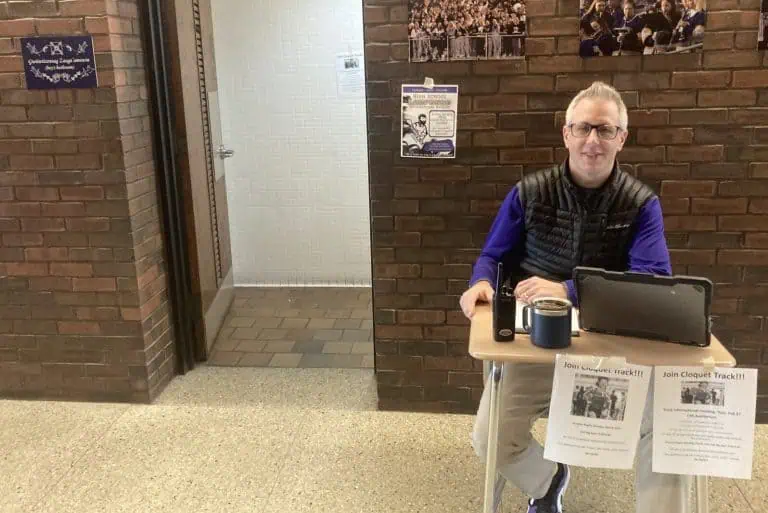
Without the aid of technology to combat this, Battaglia and his staff have to constantly patrol the restrooms, serving as a serious distraction from the staff’s other responsibilities. Battaglia has taken measures into his own hands, repositioning his work desk across from the restroom so he can constantly monitor the situation.
“Right now, the vape detectors are me and my assistant principal, who are both making significantly more money than that, so we probably have the highest-paid bathroom monitors probably in existence right now, and that’s not to mention the stuff we’re not able to get done because we’re doing that kind of stuff,” Battaglia said.
The district has tried discipline, with e-cigarette use constituting the top reason why students are suspended, but even that has brought limited success. In turn, Battaglia is confiscating a “mind-boggling” amount of paraphernalia, which at times is up to six devices a day.
From an administrative standpoint, the trouble with vaping — as opposed to more traditional tobacco products — is that it can be easily concealed. The devices are small and don’t emit smoke or an easily identifiable odor, making it difficult to identify in the first place and confront students suspected of vaping.
“It can be fairly discrete. A lot of these devices, unless you know what you are looking for, you wouldn’t necessarily know you are seeing something,” Battaglia said.
School officials don’t expect the vape detectors to be an end-all, but they are hopeful that it will put a significant enough dent in e-cigarette use that it will allow the district to get a handle on the problem. If it doesn’t, the next step is likely metal detectors, according to Battaglia.
“We’re not going to stop the teenage vaping epidemic at Cloquet High School, but our goal is: It’s got to get moved out of the restrooms,” Battaglia said. “The restrooms got to be available for anybody who wants to use the restrooms and they have to feel comfortable going in there, so we have to get the vaping out of the restrooms.”


0 Comments